Business Growth
Short-Term Stay Software: Turn Empty PG Beds Into Nightly Income
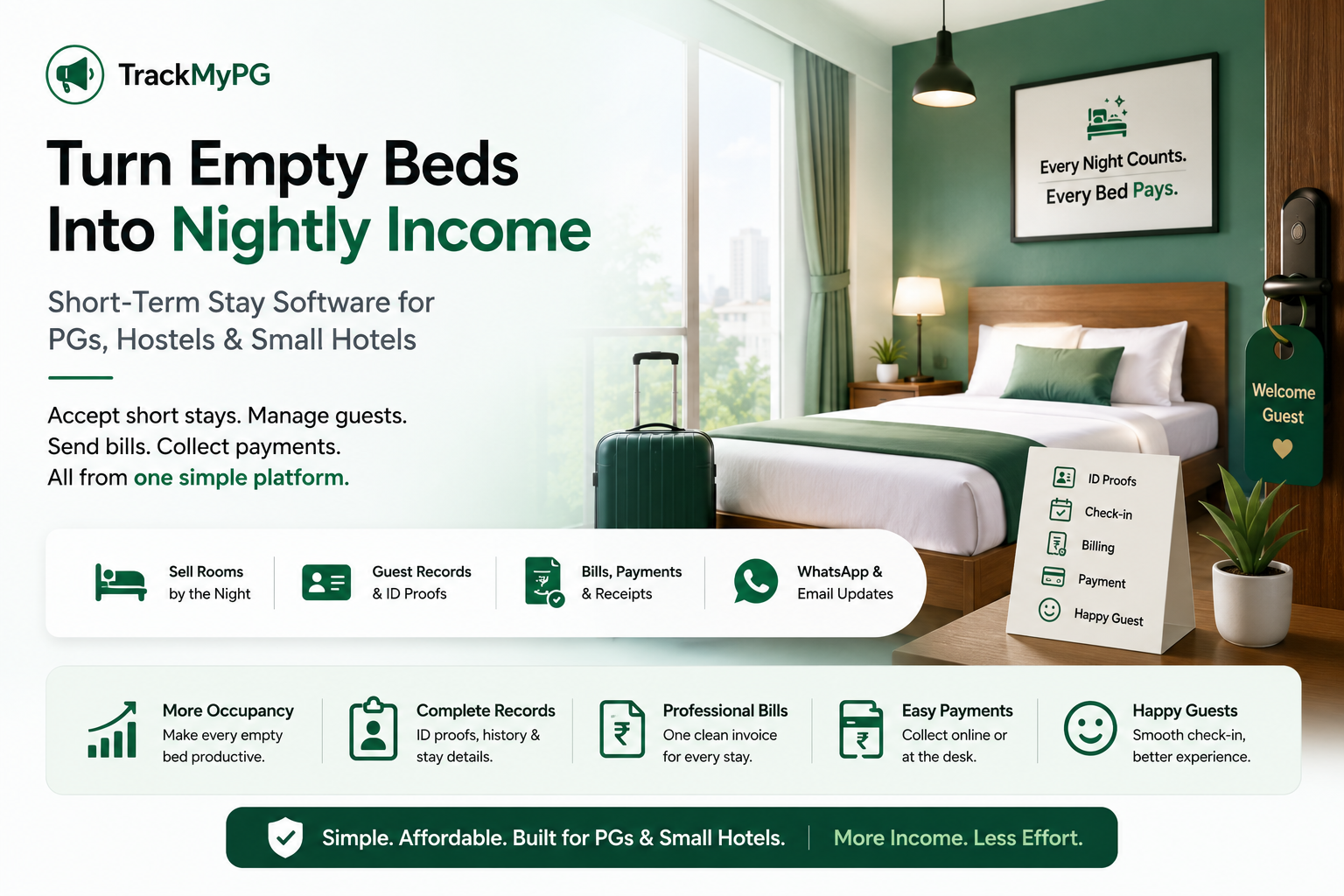
Most PG and hostel owners in India lose income to beds that sit empty between tenants, during exam seasons and over college holidays, because taking guests for a few nights means handling bookings, ID proofs, bills and payments with no system built for it. Short-Term Living in TrackMyPG lets a property sell the same rooms and beds by the night alongside its regular monthly tenants, from the same dashboard. Owners keep a permanent profile for every guest with ID documents and visit history, book multi-room stays without risk of double-booking, run one bill per stay covering nights and extra charges, collect payment by link or at the desk, and send guests automatic updates on WhatsApp and email from booking through checkout. It suits PGs, hostels, homestays, lodges, motels and small hotels that need proper guest management without the cost of a full hotel system.
Count the beds in your property that are empty tonight.
Not empty for the year — empty tonight. The bed whose tenant left on the 28th while the next one arrives on the 5th. The room you keep free in case a good long-term enquiry walks in. The whole floor that clears out every May when the college term ends and refills only in July.
That gap is bigger than most owners think. A twenty-bed PG averaging three empty beds a night is leaving somewhere between ₹9,000 and ₹45,000 a month on the table, depending on your city. And it is money that costs almost nothing extra to earn, because the building, the electricity connection, the water tanker and the caretaker are already paid for whether that bed is occupied or not.
Meanwhile the demand is already knocking. This guide is about how short term stay PG management software lets you say yes to it — properly, with records and bills, rather than as a cash arrangement scribbled in a diary.
The People You Are Turning Away Every Month
Think about the enquiries you decline because they are not eleven-month tenants:
A parent visiting their child for four days
A candidate in town for an exam or an interview
An intern on a six-week project who will never sign a yearly agreement
The family of a patient admitted at the hospital down the road
A wedding party needing eight beds for three nights
A tenant's friend who needs somewhere over the weekend
In Kota, Delhi and Hyderabad this is a steady, year-round stream. Near any big hospital, coaching hub, IT park or exam centre, it never really stops.
Most owners send all of it away. The ones who do take it usually take it badly — no ID copy, no bill, no record of who slept in the building on which night, and no way to tell at the end of the year whether it earned anything worth the trouble.
Why Owners Avoid Short Stays (And Why That Instinct Is Reasonable)
Nobody avoids this business because they dislike money. They avoid it because doing it by hand is genuinely painful.
Double-booking is a constant risk. A diary cannot tell you that bed 4 in room 203 is free from the 12th but taken again from the 16th. Promise the same bed twice and you are turning someone away at the gate at 10 PM.
ID collection is inconsistent. You take a photo of an Aadhaar card on your phone, and three months later nobody can find it. If anyone ever asks who was staying in your property on a particular date, you have nothing solid.
Billing is embarrassing. A guest who needs an invoice for their company's reimbursement does not want a WhatsApp message saying "₹3,200 received". Plenty of business travellers will simply stay elsewhere.
Nobody knows the rules. Guests turn up at odd hours, do not know the check-out time, and call the caretaker four times because nothing was written down.
Money gets mixed up. Nightly income lands in the same cash box as rent, and by month-end you cannot separate what came from tenants and what came from guests.
And you never learn anything. No record means no pattern. You cannot tell whether short stays made ₹4,000 or ₹40,000 last quarter, or whether the walk-ins were better business than the referrals.
Every one of these is a systems problem, not a business problem. The business is sound. The paperwork is what makes it feel like a headache.
What Short-Term Living Actually Gives You
Short-Term Living is a feature inside TrackMyPG, the PG management software you already use for tenants, rooms, rent and invoices. It adds a second way of filling the same rooms.
Nothing about your monthly operation changes. Tenants, rent cycles, agreements, deposits, reminders — all exactly as they are. Alongside that, the same rooms and beds can now also take guests paying a nightly rate for a short window.
Think of it as a front desk sitting on top of your PG.
Your monthly tenants | Your short-stay guests | |
|---|---|---|
Who they are | Tenant | Guest |
Commitment | Monthly agreement | A few nights |
What they pay | Monthly rent | Nights × nightly rate |
The paperwork | Agreement, deposit, notice period | Book, check in, check out |
Two income streams from one building, both visible in one dashboard.
It is switched off by default. A property that wants nothing to do with nightly guests never sees it.
Who This Is Built For
PG and hostel owners with vacancy between tenants, seasonal gaps, or a handful of rooms they would rather sell by the night than block for a year.
Small hotels, motels, lodges and service apartments that need bookings, ID capture, bills, payments and guest messaging, but cannot justify an expensive hotel system priced per room per month.
Homestays and guest houses run by one or two people, where the current system is a WhatsApp thread and a receipt book.
Working women's and student hostels near hospitals, coaching centres and exam venues, where a steady flow of people need a bed for four nights and none of them will sign an agreement for it.
If your building has beds and your calendar has gaps, this applies to you.
Getting Started Takes About Ten Minutes
Turn it on
Go to Settings → Guests and enable Short-Term Living. Guests and Stays appear in your sidebar. Your tenant workflow does not move an inch.
Put a nightly rate on the rooms you want to sell
This is the only real decision you have to make.
If you price a room as a whole room, you set one nightly rate for it. If you price by bed, you set a nightly rate on each bed you want bookable — so two beds in the same room can sell at different prices, and any bed you leave unpriced simply never shows up as available to guests.
Your monthly rent is untouched. The nightly rate is a separate number only guests ever see.
A sensible starting formula: monthly rent ÷ 30 × 2.5.
A bed you rent at ₹9,000 a month costs you about ₹300 a night. Sold as a short stay, ₹700 to ₹800 is a fair market price in most Indian cities. That gap is not greed — it covers laundry churn, the extra cleaning, the odd-hour check-ins, and the fact that nobody is committing to you beyond Thursday.
Set your house rules once
Check-in and check-out times, say 12:00 PM and 11:00 AM. Every new booking picks these up automatically, and you can override them for any individual guest.
Reminder timing — the time of day arrival and departure reminders go to guests. Most owners choose 9:00 AM.
Standard notes for your bills and receipts — your cancellation policy, your tax note, your thank-you line.
That is the whole setup. You are open for nightly business.
Guest Profiles: The Part That Pays Off Next Year
Every person who stays with you gets a permanent profile. Not a booking record — a record of the person.
It holds their name, phone, email, date of birth, nationality and photo. It holds their identity documents — Aadhaar, PAN, passport, driving licence — with scanned copies attached and one marked as primary. It holds emergency contacts, permanent address, whether they are a student or working professional with their college or company, their preference for WhatsApp or email, any special requirements, and your own private notes about them.
Sensitive details like Aadhaar and PAN numbers are masked wherever they appear on screen. You are collecting government ID from strangers, and it is treated with the seriousness that deserves.
Each guest also gets a short readable ID you can say out loud on a phone call, which saves a lot of spelling names back and forth.
Then the useful part builds itself. Every profile carries the guest's history — how many times they have stayed, when they last came, and what they have spent with you across every visit.
The second time that person books, you type nothing. Search their phone number, their whole history comes up, and they are booked in seconds. Over a year, a hostel near a hospital or an exam centre quietly builds a real list of repeat guests: people who stayed four nights in March and will need four more in September. That list is a genuine business asset, and almost no PG has one, because almost no PG ever wrote anything down.
Finding anyone is a single search box that accepts a name, phone number, email, ID number or guest ID.
Difficult guests are handled without losing anything. Mark a profile blocked and that person cannot be booked in again, including by someone re-entering their phone number as a fresh guest. Mark it archived to tidy away a profile you no longer need. History stays intact either way, so a question two years later still has an answer.
Booking a Stay Without Ever Double-Booking
A booking answers four questions.
Who — pick an existing guest or create the profile first. You end up with one clean profile per person, not four near-duplicates from four visits.
When — arrival and departure dates, with times already filled in from your house rules.
Where — a list of everything genuinely available for those dates, with the nightly rate shown against each option. Anything occupied by a tenant, held by another guest, unpriced, or not opened up for short stays simply does not appear. There is nothing to get wrong, because the wrong choices are not offered.
How much — the rate comes from the room or bed you picked.
One booking can cover several rooms. A family taking three rooms for four nights is one stay, not three bookings you have to reconcile later. Each room keeps its own rate and it all bills correctly on a single bill.
Then the details that matter afterwards:
How many people are staying, and who they are — every additional occupant recorded by name with an ID document. This is your register entry for everyone under your roof, not just the person who paid.
Why they are here — personal, work, education, travel, medical
Where the booking came from — walk-in, phone, WhatsApp, your website, a referral, a listing partner
Special requests — ground floor, extra mattress, early breakfast
Every stay gets a short code you can quote on a call or write on a printed slip.
And the everyday case works the way it should: a guest checking out on the 12th frees that bed for a guest arriving on the 12th. Departure day and arrival day are the same day.
Preventing double-bookings is worth the setup on its own. Promising the same bed twice is the single most expensive mistake in short-stay lodging, and a paper diary makes it regularly.
Running the Day
The Stays screen is your front desk.
Today's arrivals and today's departures are one click each, with counts on them. The morning question — who is coming, who is leaving, which rooms need cleaning — is answered before your first cup of tea. Tomorrow's lists are one click further, for evening prep.
You can filter by where a stay is in its life — arriving soon, checked in, checked out, cancelled — or by money: unpaid, partly paid, paid. Combine the two and "who is here or arriving and still owes me money" becomes a two-click question instead of an evening with a notebook.
A stay moves through four honest states:
State | What it means |
|---|---|
Upcoming | Booked, not yet arrived, bed held |
Checked in | Here now |
Checked out | Been and gone |
Cancelled | Never happened, bed released |
When a Guest Wants to Stay Longer
This is the most common thing that happens after a booking, and it takes one action.
Open the stay, choose a new departure date, and the extra nights are added at the rate they originally booked at. If your prices have gone up since, that is a decision for their next booking, not an unpleasant surprise for somebody already asleep in the bed.
If they are holding several rooms, you can extend all of them or only some. That covers the classic case where three rooms were booked, two people are staying on, and the third leaves as planned — and the room that is not extending goes back on sale for its original date.
Extensions are added to the guest's existing bill. One stay, one bill, however many times it grows.
One Bill Per Stay, Paid However They Want
Every stay carries a single running bill.
It starts as nights multiplied by the nightly rate for each room booked. Onto it you can add:
Extensions as they happen
Your own charges — laundry, a damaged mattress, late check-out, an extra bed, a meal, parking
A discount for a long stay, a repeat guest, or a tenant's friend
Tax, if you charge it
Add a charge the moment it happens. Add one to a bill that is already settled and it simply shows as newly due, which is exactly what should happen when a guest breaks something on their last night.
Collecting the money works the way the rest of TrackMyPG does. Send a payment link and the guest pays online from their phone, even before arrival if you want the booking confirmed with an advance. Or record what they hand you at the desk — cash, UPI, card or transfer.
Part payments are completely normal. Take an advance at booking, the balance at checkout. The stay clearly shows as unpaid, partly paid or paid, so you always know where you stand.
Both an invoice and a receipt PDF are produced, carrying your property's details and the standard notes you set up once. The guest who needs a bill for their employer gets a proper one — and that guest, incidentally, is often your most reliable repeat business.
Guest bills sit in the same Invoices screen as your tenant rent invoices, so all your money is in one place. But they stay counted separately where it matters. Your rent collection figures, rent reports and tenant reminders remain about tenants, and nightly income never quietly inflates them.
Checking Out
Checkout is one screen showing the final bill: every charge, every extension, every extra, every discount, what was billed in total, what has been paid, and what remains.
Three things are worth knowing.
A guest can leave still owing money. That happens in lodging. Refusing to check someone out until they pay only means your records claim a room is occupied when the person left an hour ago. So checkout with a balance is allowed, but it is a deliberate confirmation rather than an accidental click.
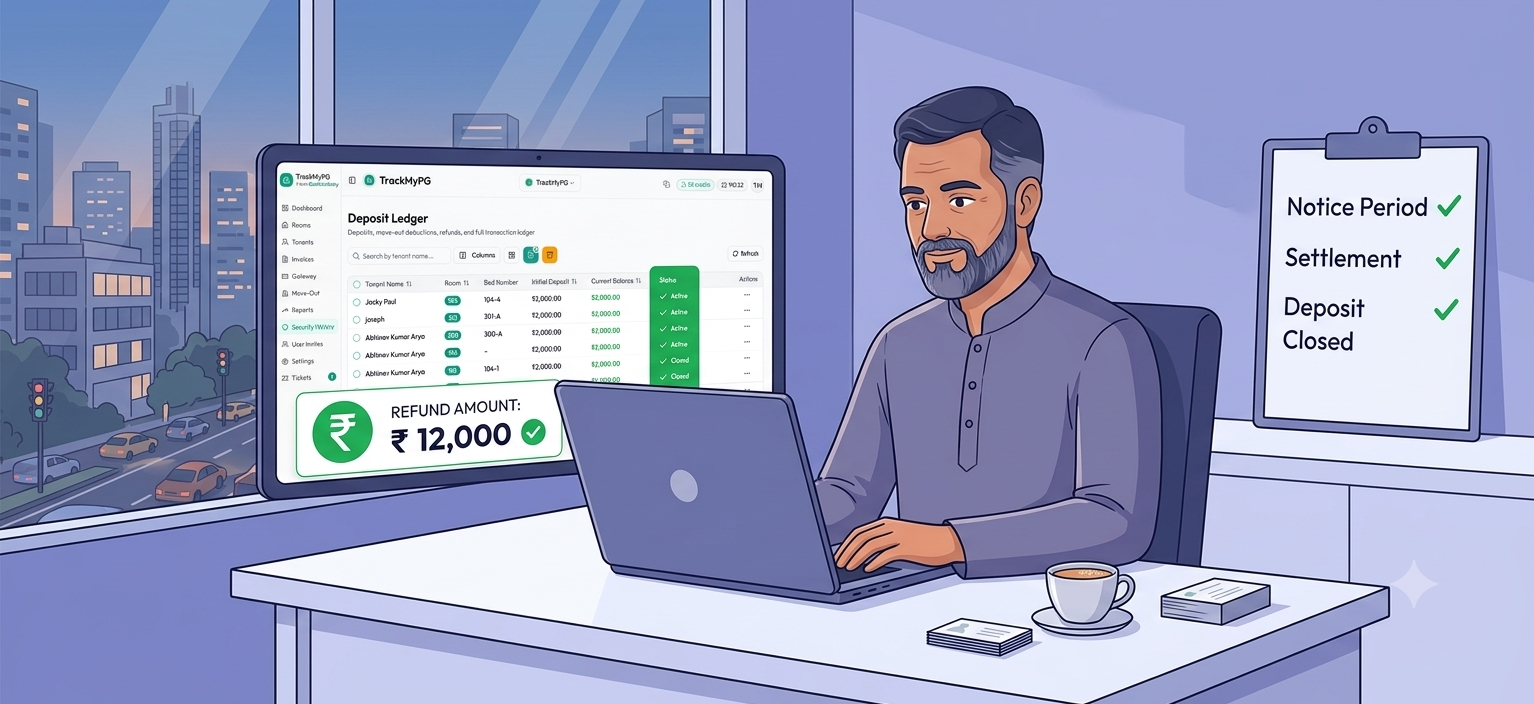
Early departures are shown, not swallowed. If someone booked six nights and leaves after four, you are told exactly how many nights went unused and what they were worth. Whether you refund, adjust or keep it is your policy and your decision.
The bed is free the moment they walk out, ready for the next booking.
Guests Who Get Messaged Are Guests Who Come Back
This is the difference between feeling like a professional property and feeling like a favour from a stranger on the internet.
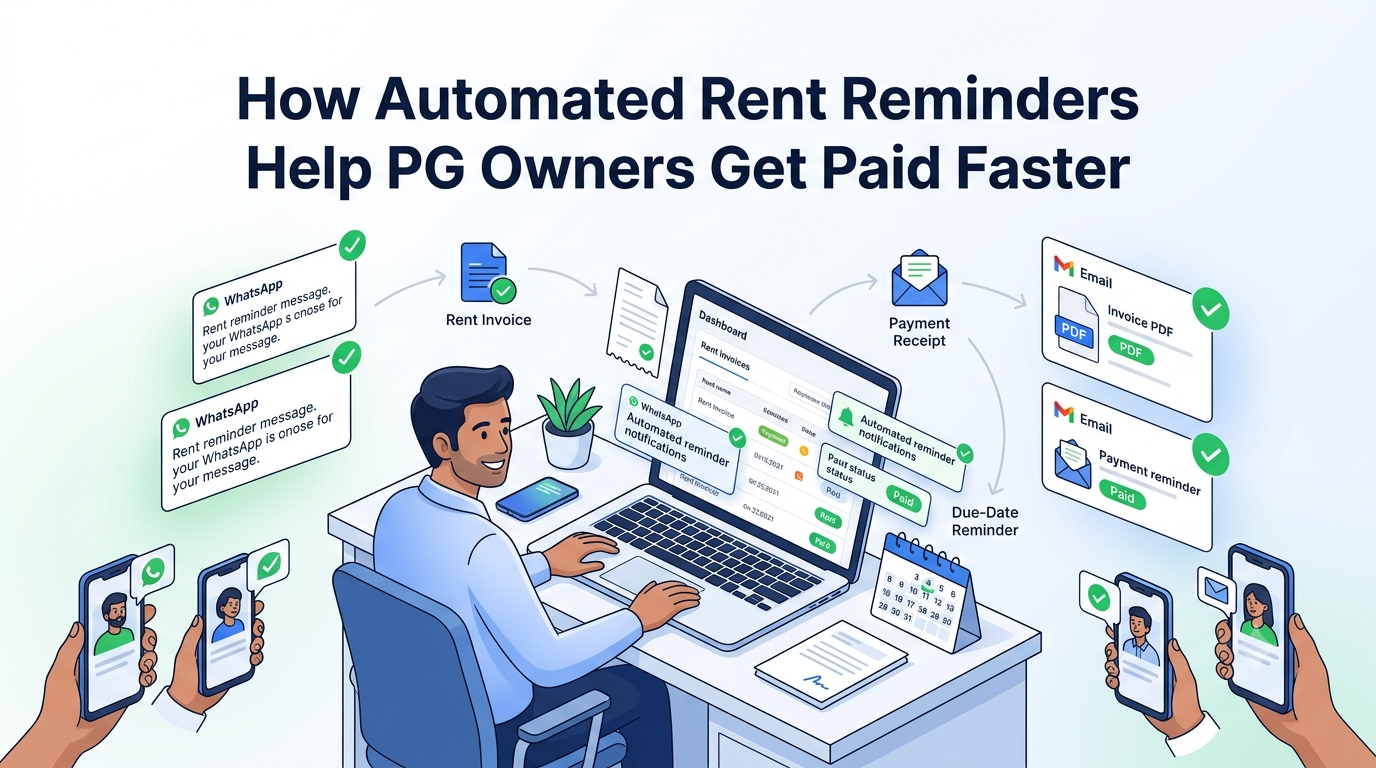
TrackMyPG messages your guests on WhatsApp and email at nine points in their stay:
Moment | What they receive |
|---|---|
Booking confirmed | Dates, room, check-in and check-out times, your property name |
Arrival reminder | A nudge on the morning they are due |
Checked in | Confirmation they are in |
Stay extended | New departure date and what it costs |
Bill raised | Their invoice, with a way to pay it |
Payment received | An immediate receipt |
Payment due | A polite reminder about an outstanding balance |
Departure reminder | On checkout morning, with the time |
Checked out | A closing note and the final bill |
You control every one of them. Each can be switched on or off, and set to email only, WhatsApp only, or both. Arrival and departure reminders go out at the time of day you choose. The wording of the emails is yours to edit, so it carries your property's voice, your rules and your contact number.
Messaging is charged from your communication wallet or plan credits, only for messages that actually deliver. A four-night guest messaged at every stage on both channels costs a couple of rupees.
Think about what that buys. A guest who arrives at the room they were promised, at the time they were told, and finds a proper receipt on their phone afterwards is a guest who books you again and mentions you to three other people. In a business that runs almost entirely on word of mouth, that is the cheapest marketing you will ever do.
Announcements reach your guests too
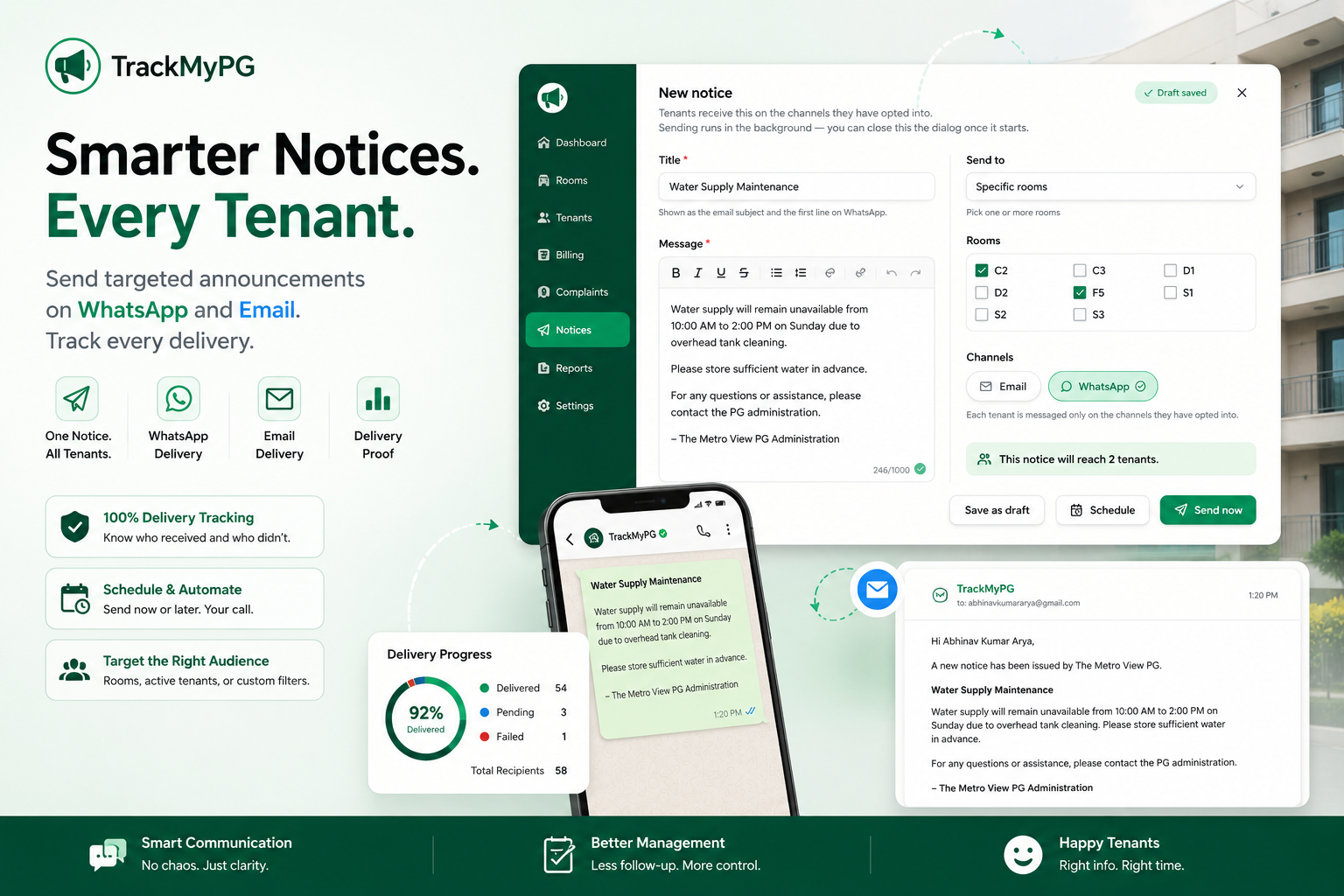
If something affects everyone in the building — water off Sunday morning, lift maintenance, a change in gate timings — you can broadcast a notice to your current guests as well as your tenants, either everyone in-house or only particular rooms. They are living under your roof this week. They should hear about the water.
What the Numbers Finally Tell You
The honest question about any new income stream is whether it was worth the effort. You get an answer.
Guest and stay register — who stayed, when, where they came from and why, with counts of checked-in, upcoming and completed stays, plus your repeat guest rate. This doubles as the record you want if anyone ever asks who was in your building on a particular night.
Stay revenue — what was billed against what was actually collected, for any period you choose.
And if your plan includes the analytics hub, three things you cannot judge by eye:
Nights sold against nightly rate, month by month. These two numbers only mean something together. Selling more nights at a falling rate is not growth.
How long guests actually stay, which is almost never what owners assume. If most of your business is two nights, your minimum-stay rule and your cleaning schedule should reflect that.
Which booking sources bring money, not just bookings. Walk-ins who stay one night are a different business from referrals who stay a week, and knowing the difference tells you where to spend your effort.
Your dashboard also carries a small card answering the daily question: is anyone arriving or leaving today?
Diary and Cash Box vs Proper Guest Management
Notebook and WhatsApp | Short-Term Living in TrackMyPG | |
|---|---|---|
Double-booking risk | High, and expensive | Unavailable beds are never offered |
ID records | Photos lost in a phone gallery | Attached to a permanent guest profile |
Bills | A WhatsApp message | Proper invoice and receipt PDFs |
Repeat guests | Forgotten between visits | Full history on every profile |
Guest communication | Manual, or nothing | Automatic at nine stages |
Separating rent from stay income | Nearly impossible | Separate by default |
Knowing if it was profitable | A guess | Nights, rate, revenue and source, reported |
Why TrackMyPG Is the Best PG Management Software for Short Stays
Plenty of booking tools exist. Almost all of them assume you are only a hotel, and none of them know anything about your monthly tenants.
That is the real problem with running a separate booking app alongside your PG. Your rooms exist in two places. Your money lands in two reports. A bed occupied by a monthly tenant is invisible to your booking tool, so the double-booking you were trying to avoid is exactly what you get.
Because TrackMyPG already runs your property, short stays sit naturally on top of everything you maintain daily:
Your rooms are just your rooms. No parallel inventory, no second list to keep in sync. You mark which ones can take guests, put a nightly rate on them, and that is all.
Availability accounts for tenants and guests together, which is precisely why a bed can never be sold twice.
Your staff already have access. Anyone you trust with tenants can handle guests and stays. There is no new permission to hand out and nobody new to train from scratch.
All your invoices live in one screen, tenant and guest alike, while your rent figures stay purely rent figures.
Your messaging never crosses wires. Tenants get tenant messages, guests get guest messages, and neither ever receives the other's.
One subscription. No per-room hotel licence on top of what you already pay.
The same platform also handles rent collection, tenant records and invoicing for your long-term residents, so an owner running properties across Bangalore, Pune and Delhi manages both sides of the business from one login.
Being Straight About What It Is Not
It would be easy to oversell this, so here is the honest boundary:
Guests do not get a tenant portal. No login, no agreement, no security deposit, no monthly rent cycle. A short stay is a short stay.
There is no channel manager. It does not push your rooms onto travel booking sites. You can record where a booking came from, but you make the booking.
There is no housekeeping rota built in. You will run cleaning your own way — the arrivals and departures lists tell you which rooms need attention.
It is not a full hotel system, and does not pretend to be. It is the useful eighty percent — bookings, guests, ID records, bills, payments, messaging and reports — without the weight and cost of the rest.
For a PG with empty beds, a homestay, a lodge or a twelve-room hotel, that eighty percent is the entire job.
Turning It Off, If You Ever Want To
You can switch Short-Term Living off again, but not while it would strand somebody.
If a guest is currently checked in, or a guest bill is still unpaid, you are told to finish that first. Nothing gets deleted. The software just will not let you hide a person who is asleep in one of your rooms, or a bill that nobody will chase once it is out of sight. Complete the stay, settle the money, then switch off. Your records stay exactly where they are.
A Practical First Month
Week one — start small. Turn the module on. Price two beds for nightly stays, not twenty. Set your house times. Take one booking, even from a tenant's visiting relative, and walk it all the way through: book, check in, bill, check out. You will understand the whole thing in an afternoon.
Week two — stop saying no. Every enquiry you would previously have turned away, take it. The four-night visitor. The six-week intern. The exam candidate. Record the booking source honestly every single time — that field is worthless if you fill it in casually and valuable if you do not.
Week three — build the profiles properly. Photo, ID, emergency contact, every time, no exceptions. It takes ninety seconds at the desk and it is the difference between a guest list and a pile of loose bookings.
Week four — read the numbers. Nights sold. Revenue billed against revenue collected. Average length of stay. Which sources brought money rather than noise. Then decide how many more beds to open, and at what price.
The Point of All This
You already own the building. You already pay the electricity, the water, the caretaker and the internet. On every night a bed sits empty, all of those costs run anyway.
Short-Term Living does not ask you to become a hotelier. It asks you to stop leaving money in empty rooms, and gives you the records, the bills, the ID trail and the guest messaging to do it properly instead of as a cash arrangement in a notebook.
Same building. Same beds. Same staff. One more way to earn from all three.
Open Settings → Guests in your dashboard and switch on Short-Term Living, or see how TrackMyPG works if you are not on the platform yet.
Frequently Asked Questions
Run your PG smarter, not harder
Collect rent on time, track tenants, and stay on top of every room — without spreadsheets.
Start 7-day Trial for ₹1 →- Rent invoices & payment tracking
- Tenant & room management in one place
- Reports built for PG owners in India
Share this article
Share "Short-Term Stay Software: Turn Empty PG Beds Into Nightly Income" on social media or copy the link.