Tenant Management
PG Tenant Verification in India: The Complete 2026 Guide for Owners (With Checklist)
Learn how to verify PG tenants in India the right way — Aadhaar, police verification, rental agreements, and how software makes the entire process faster and dispute-proof. PG tenant verification India, tenant verification for PG owners police verification for PG tenants how to verify tenants in PG
You found a tenant. They seem decent. They're willing to move in this weekend.
And somewhere in the back of your head, you know you should verify them properly — but you're not sure what "properly" actually means. What documents do you need? Is police verification mandatory? What if they refuse to give you their Aadhaar? What happens if you skip all this and something goes wrong?
This guide answers every one of those questions — clearly, practically, without the legal jargon.
If you're running a PG, hostel, or paying guest accommodation anywhere in India, tenant verification isn't just paperwork. It's how you protect your property, your existing tenants, and your business from problems that are much harder to fix once they've started.
Let's get into it.
Why Tenant Verification Matters More Than PG Owners Realise
Most disputes in PG management — non-payment, property damage, sudden abandonment, security incidents — have one thing in common: they were completely avoidable with proper verification at the start.
When you skip verification, you're not just taking a chance on one tenant. You're taking a chance that affects every other tenant living in your property, your cash flow, and your legal standing.
Here's what actually goes wrong when verification is skipped:
Non-payment with no recourse. A tenant leaves without paying three months of rent. You have no verified address, no emergency contact, no employer details. There's nowhere to even begin recovery.
Disputes with no documentation. A tenant claims they paid a certain amount. You have no signed agreement, no receipt trail, no way to prove otherwise. Even if you're right, you can't demonstrate it.
Security incidents that damage reputation. Other tenants complain about behaviour from a new tenant. You have no verified background, no references. The problem festers until someone leaves — and it's not always the tenant who caused it.
Police or legal trouble without records. In cities like Bangalore, Pune, and Hyderabad, local police increasingly require PG owners to have verified tenant records. If an incident occurs and you can't produce documentation, the liability falls on you.
Proper PG tenant verification takes 20 to 30 minutes upfront. It saves hours of problems later.
What Documents Should You Collect from Every PG Tenant?
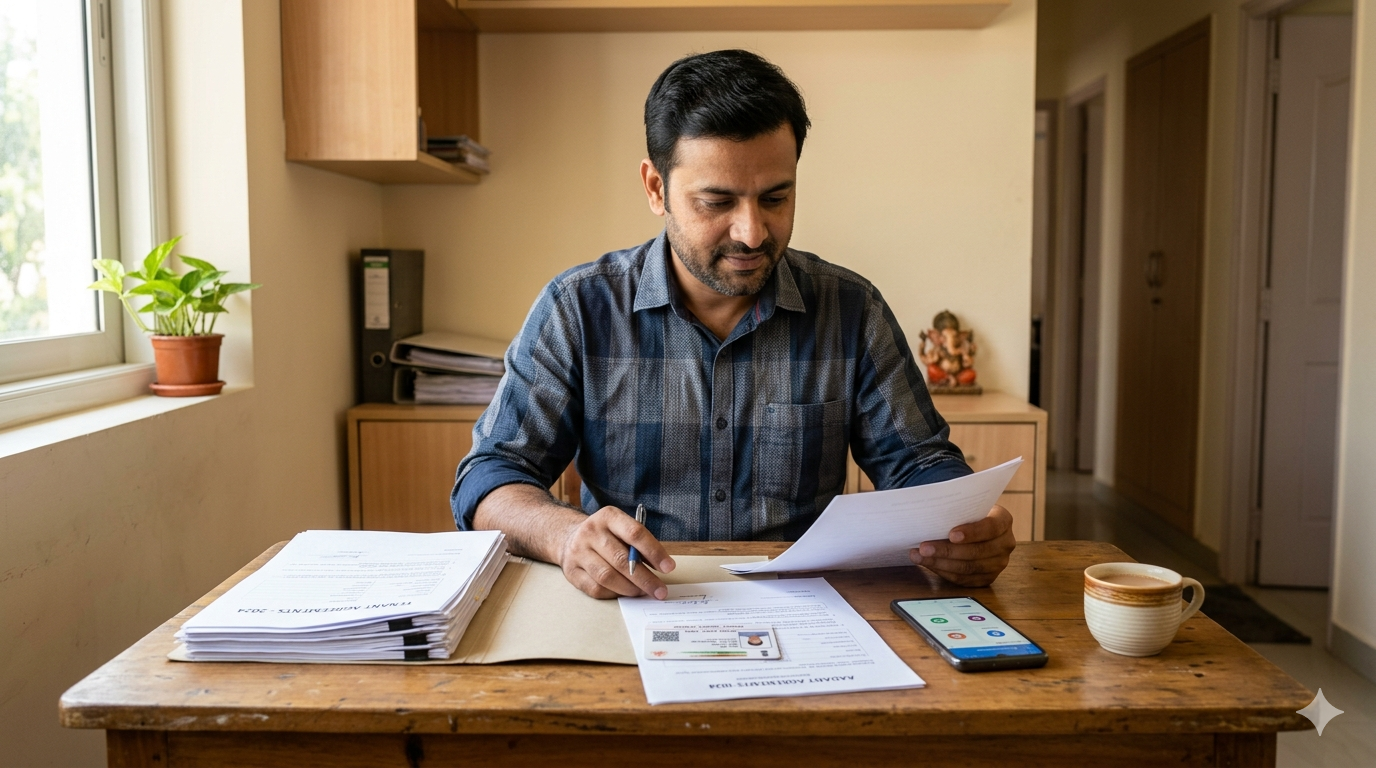
This is the practical starting point. Here's what to collect from every new tenant before they move in — no exceptions.
1. Government-issued Photo ID (mandatory)
Collect any one of:
- Aadhaar card — most preferred, digitally verifiable
- Passport — strongest proof for address and identity
- Voter ID
- Driving licence
- PAN card — acceptable for identity, not for address proof
Aadhaar is by far the most common and most useful in Indian PG operations because it contains both identity and address in one document. Most tenants have it readily available.
Important: You cannot legally force someone to give you their Aadhaar number under the current legal framework — but you can require them to show a government-issued ID before renting. Most tenants will voluntarily share Aadhaar as it's the easiest to provide.
2. Address Proof (current residence, not permanent)
Collect something that shows where they're coming from:
- Aadhaar (if address matches)
- Utility bill (electricity, water) in their or parent's name
- Bank passbook or statement with address
- Previous rental agreement
For students, a college ID with hostel address, or a letter from the institution, works in practice.
3. Proof of Purpose (employment or education)
- Working professionals: Employer ID card, offer letter, salary slip, or company letter confirming employment
- Students: College ID, admission letter, or fee receipt showing the institution name
This matters because it helps you understand the tenant's stability and whether their stated purpose for being in the city is real.
4. Emergency Contact
Name, phone number, and relationship of someone who can be reached if the tenant is unresponsive. This is your fallback for unpaid rent, abandoned belongings, or medical situations.
5. Passport-size Photographs (2 copies)
Still required in many formal processes, and useful for your physical tenant register if you maintain one.
Is Police Verification Mandatory for PG Owners in India?
This question causes a lot of confusion because the rules vary by state and city. Here's the honest answer: in many cities, yes — you are legally expected to inform local police about new tenants.
Cities where it's most actively enforced:
- Bangalore (Bengaluru): Bangalore City Police requires PG owners to submit tenant details to the nearest police station or through the online Suraksha portal. Non-compliance can result in notices.
- Delhi/NCR: Police verification for tenants is recommended and is increasingly being asked for in residential areas.
- Mumbai: Police have periodically run drives requiring landlords and PG owners to verify and register tenants.
- Hyderabad and Pune: Similar advisory requirements from local police departments.
How the process typically works:
- Tenant fills a tenant declaration form (available at local police stations or online portals in most cities)
- You as the PG owner submit this along with the tenant's ID proof to the nearest police station or the city's tenant registration portal
- A record is created in the police system
- In some cities, verification happens within a few days — the tenant may receive a call or visit
The practical reality:
Many PG owners in smaller cities don't do police verification because enforcement is sporadic. But the legal risk sits with you. If anything happens involving a tenant who was never verified, you're in a far weaker position — legally and practically.
The safest approach: collect the documents, fill the form, submit it. It takes 30 minutes once you've done it the first time.
The Rental Agreement: Don't Skip This
A signed rental agreement is not optional. It's the document that defines the entire relationship between you and your tenant — and without it, you have no enforceable terms.
What a PG rental agreement should include:
Identity and property details:
- Full name, permanent address, and contact of both owner and tenant
- Property address, room number, and any bed assignment
Financial terms: - Monthly rent amount (in words and numbers)
- Security deposit amount and refund conditions
- Electricity and utility charge structure (fixed or unit-based)
- Service and maintenance charges
- Payment due date and late fee policy
Occupancy terms: - Move-in date
- Notice period required before vacating (typically 30 days)
- Guest policy (overnight guests, frequency)
- Maximum occupancy of the room
Rules and responsibilities: - Property damage liability
- Common area usage rules
- Noise and quiet hours
- Whether cooking is allowed
- Pet policy
Termination conditions: - Grounds for immediate termination
- Notice periods for both parties
- What happens to security deposit at exit
Should it be registered?
For agreements under 11 months, registration is not legally required in most Indian states. Most PG rental agreements are made for 11 months and renewed, specifically to avoid the registration requirement. An unregistered but signed and witnessed agreement is still admissible as evidence in civil courts.
For agreements of 12 months or more, registration is advisable.
Keep two signed copies — one for you, one for the tenant. If you're using tenant management software, store a digital scan in the tenant's profile so it's always accessible.
The Tenant Onboarding Checklist (Save This)
Use this for every new tenant. No exceptions.
Before move-in:
- Collect government photo ID (Aadhaar preferred)
- Collect address proof
- Collect employment or student proof
- Collect emergency contact details
- Collect 2 passport photographs
- Execute and sign rental agreement (two copies)
- Collect full security deposit
- Collect first month's rent
- Issue written receipt for deposit and rent
- Submit tenant details to local police (where required)
- Take photos of room condition before move-in
- Create tenant profile in your management system
On move-in day:
- Walk through the room together
- Note meter reading (electricity) and record it
- Hand over keys against signature
- Share house rules in writing (WhatsApp message works)
- Save contact details in your phone and your system
After move-in:
- Generate first invoice and share it
- Add tenant to reminder cycle in your software
- File all physical documents in a labelled folder
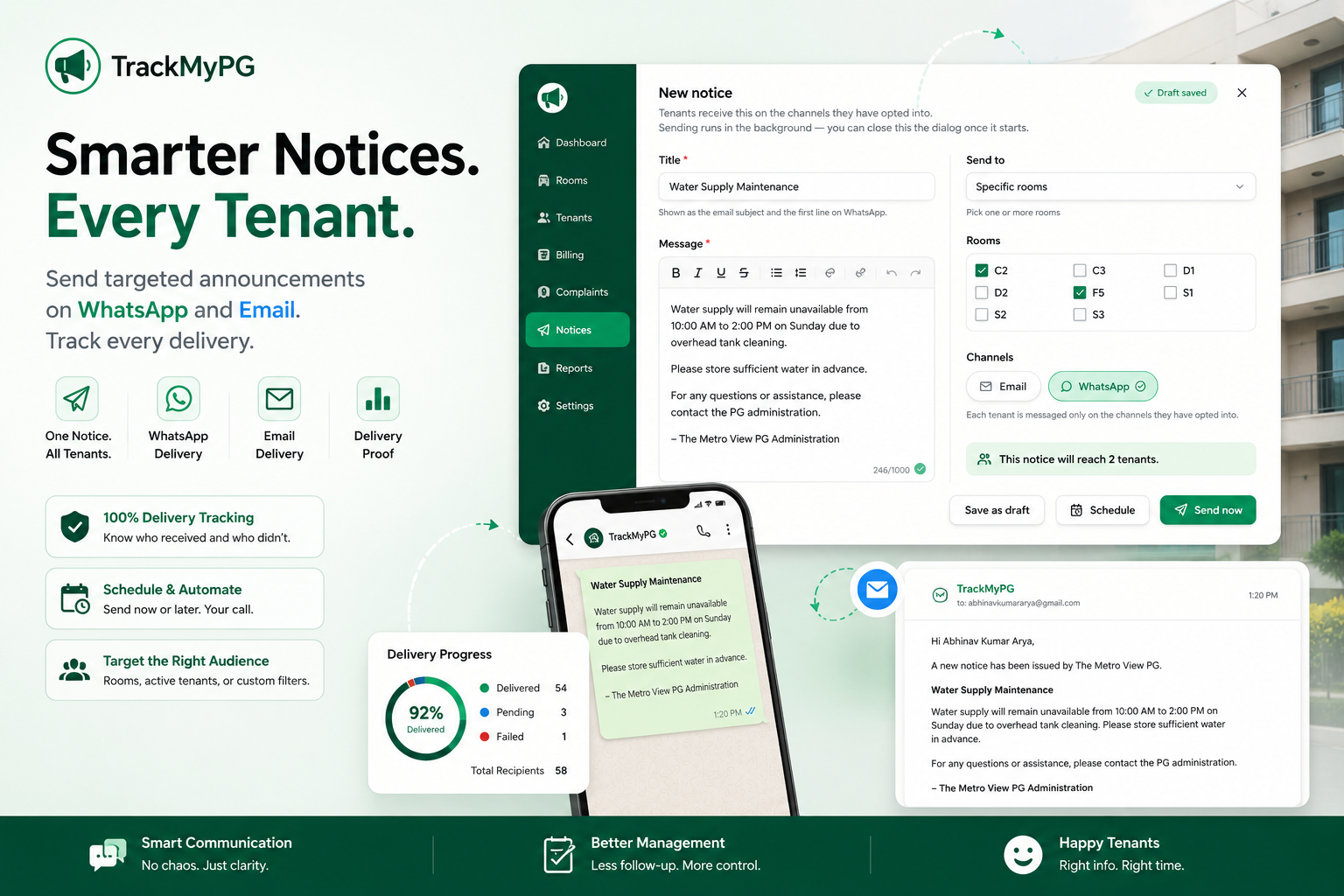
How PG Management Software Makes Tenant Verification Faster
Doing this manually — paper forms, physical folders, Excel sheets — works but creates its own problems. Documents get lost. You can't easily search for a tenant's ID proof six months later. When a tenant disputes something, you're digging through files.
Good PG management software like TrackMyPG solves this at the source.
Document storage per tenant
Every tenant profile can store scanned copies of their ID proof, employment letter, rental agreement, and photographs. Everything is in one place, accessible from your phone or laptop, searchable by name or room number.
When you need to produce a tenant's Aadhaar for police verification follow-up, it's there in 10 seconds — not buried in a drawer.
Self-registration link for new tenants
Instead of collecting information manually, TrackMyPG lets you send a self-registration link to prospective tenants. They fill in their details, select an available room or bed, and upload their documents. The information goes directly into the system.
You review it, verify the physical documents on move-in day, and the profile is complete. It saves 20 minutes of data entry per tenant and reduces errors significantly.
Automatic room availability
The system only shows prospective tenants rooms and beds that are actually available. No double-booking. No confusion about what's occupied and what isn't.
Tenant history and audit trail
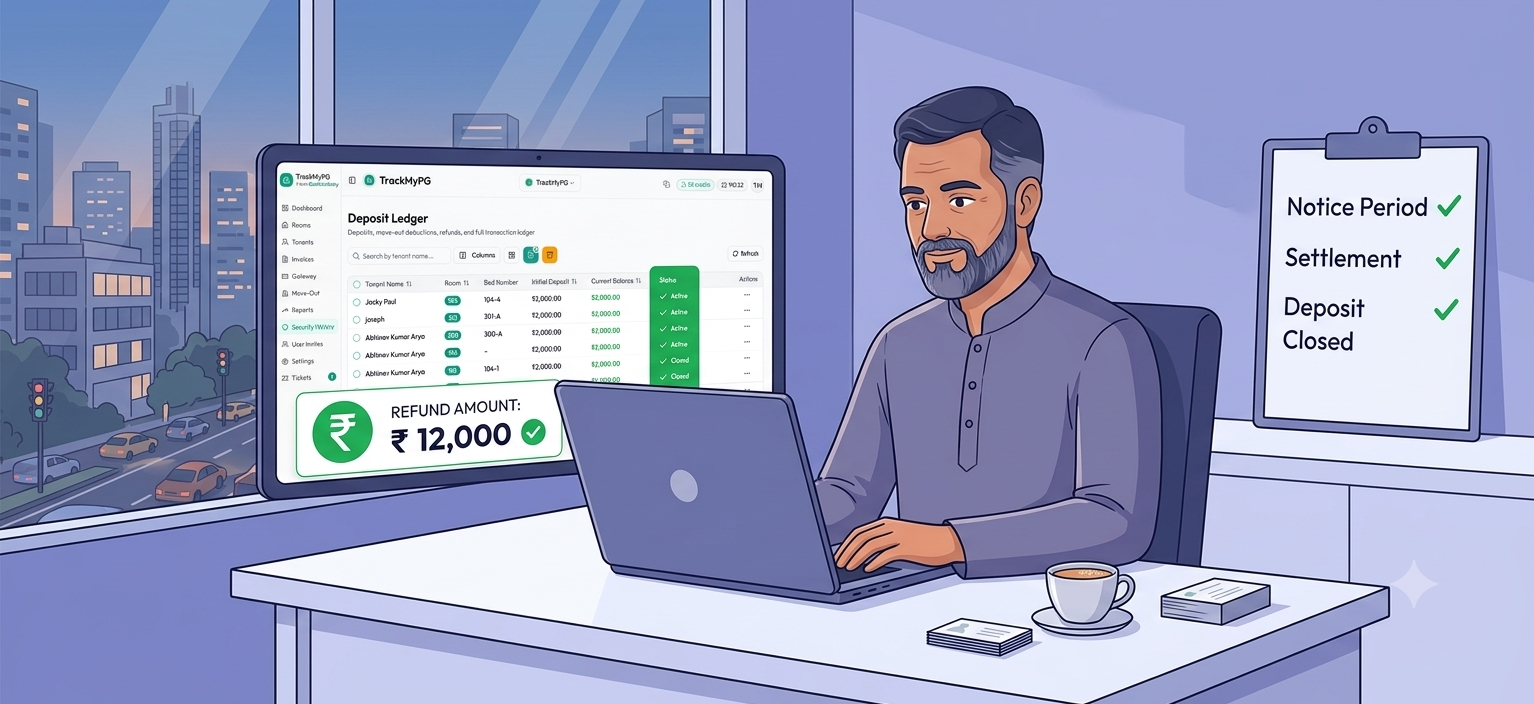
When a tenant moves out, their profile doesn't disappear. It archives with their complete history: move-in date, every invoice generated, every payment made, security deposit collected and refunded, any notes you added. This is your paper trail if a dispute comes up three months after they've left.
Why TrackMyPG Is the Best PG Management Software for Indian Owners
There are a few tools in the market targeting Indian PG owners. Most handle invoicing passably but fall short on the operational details — tenant onboarding, document management, security deposits, and move-out workflows.
TrackMyPG was built specifically for Indian PG operations, which means it handles the things other tools treat as afterthoughts.
Tenant management that reflects how PGs actually work. Room-wise and bed-wise pricing, mid-month joiners, notice period tracking, tenant mates (roommates under the same primary tenant) — all of this is built in, not bolted on.
Billing that runs itself. Configure your electricity rate, service charges, generation date, and due date once. After that, invoices generate automatically every month for every tenant. You review and send. No manual calculation.
Security deposit tracking with a full audit trail. Every deposit is logged from day one. Deductions are documented with reasons. Refunds are tracked to completion. When a tenant asks "why was ₹2,000 deducted," you have a clear, timestamped answer.
Online rent collection via Indian payment gateways. Razorpay, PayU, Cashfree, and Easebuzz are all supported. Tenants pay via a link directly from their invoice. No chasing, no cash reconciliation.
Multi-property from one login. If you run more than one PG, switch between them from the top navigation. Each has its own dashboard, tenant list, and reports. Consolidated view is one click away.
Team access with roles. Invite a manager or caretaker with limited access. They see what they need; they can't access financials they shouldn't.
The result is a hostel management system that handles the full lifecycle — from tenant onboarding and document collection to monthly billing, payment tracking, security deposit refund, and final move-out — in one place.
Common Tenant Verification Mistakes PG Owners Make
Even experienced owners make these. Knowing them helps you not repeat them.
Accepting copies without seeing originals. Anyone can photocopy an edited document. Always verify the original on move-in day, even if you collected a scan earlier.
Skipping verification for "known" tenants. A referral from a friend feels safe. But if something goes wrong, the same absent documentation creates the same problems. Verify everyone equally.
Not recording meter readings at move-in. This single habit prevents the most common billing disputes. Take a photo of the meter with the tenant present on day one.
Collecting documents but not organizing them. A pile of loose photocopies in a folder is almost as bad as nothing. They get lost, mixed up, or damaged. Use a digital system or at minimum a labelled folder per tenant.
Letting the rental agreement go unsigned because "we trust each other." Trust is good. A signed agreement is better. The agreement protects the tenant too — it prevents you from changing terms arbitrarily. Both parties benefit.
Not updating records when tenants change rooms. Mid-stay room changes are common. If your records still show Room 4 for a tenant now in Room 7, every subsequent invoice and document reference is wrong. Update immediately.
Frequently Asked Questions
Is it legal to ask for Aadhaar from a PG tenant in India?
You cannot legally compel someone to share their Aadhaar number or biometric data under the Aadhaar Act. However, you can require government-issued photo ID as a condition of renting, and tenants can voluntarily share their Aadhaar. In practice, most tenants share it willingly as it's the most convenient ID they carry.
What if a prospective tenant refuses to provide ID or documents?
That is a significant red flag. Any legitimate tenant — student or working professional — will have and be willing to share standard identity documents. Reluctance to provide basic verification is a valid reason to decline tenancy.
How long should I keep tenant documents after they move out?
Keep them for at least two years after move-out. Disputes over security deposits, property damage, or unpaid dues can surface months after a tenant leaves. Having the agreement, ID proof, and payment records available protects you in those situations.
Is a WhatsApp conversation about rent terms legally valid in India?
WhatsApp messages can be used as evidence in civil disputes in India, but they are far weaker than a signed written agreement. Don't rely on chat conversations as a substitute for a proper rental agreement.
Do I need separate police verification for each tenant in a shared room?
Yes. Each person occupying your property — regardless of whether they're the primary tenant or a roommate — should be individually verified and, where required, individually reported to the police. Shared occupancy doesn't mean shared verification.
Can PG management software help with police verification?
Software like TrackMyPG can store all the necessary tenant documents in a structured, accessible format — making it significantly faster to compile the information needed for police verification submissions. The actual submission is still done by you through the relevant portal or station, but having the records organized means you're not scrambling to find papers.
What is the notice period a PG tenant must give before vacating?
This depends entirely on what's in your rental agreement. The standard in most PGs is 30 days written notice. Without a clear clause in the agreement, this becomes a verbal dispute. Write it in — it protects you when a tenant decides to leave on three days' notice.
The Bottom Line
Tenant verification in a PG is not bureaucracy for its own sake. It's the foundation that makes everything else — rent collection, deposit management, dispute resolution, and long-term operations — work properly.
The 30 minutes you spend verifying a tenant at the start is not overhead. It's insurance against the 30 hours you'd spend dealing with the consequences of skipping it.
Do it for every tenant. Document everything. Use a system that keeps those records organized and accessible.
And if you're still managing tenant records in a notebook or a spreadsheet that you update manually — there's a better way.
Start your free trial with TrackMyPG → https://trackmypg.com
Add your properties, set up your rooms, and manage tenant onboarding, billing, and payments from one place built specifically for Indian PG owners.
Run your PG smarter, not harder
Collect rent on time, track tenants, and stay on top of every room — without spreadsheets.
Start 7-day Trial for ₹1 →- Rent invoices & payment tracking
- Tenant & room management in one place
- Reports built for PG owners in India
Share this article
Share "PG Tenant Verification in India: The Complete 2026 Guide for Owners (With Checklist)" on social media or copy the link.